Introduction
It starts with a rumor, a headline, a whisper that proliferates faster than any press release. By the time markets open, it’s an emotion. In China, panic is taking that form. The stock indexes have been plummeting with an unnerving ferocity, and it’s not because of a particular directive or a set of numbers it’s an attitude, an attitude that the old demons of the trade war with America have returned, and this time, they may not be limited to trade.
What is happening is not simply a market correction but a crisis of confidence. Investors are no longer simply responding to economic indicators but are instead responding to the uncertainty of a world where two great powers are using trade as a tool of warfare again.
The anatomy of a sell off
Every market has its own rhythm, and currently, the Chinese markets have been beating too fast. The Shanghai Composite Index and Shenzhen Index have both plummeted, pulling Hang Seng in Hong Kong with them. Foreign investors are withdrawing their investments, local investors are covering losses, and ‘any optimism over a post pandemic bounce back is fading rapidly.
What are the causes of this sudden deterioration? No single action, but a series of measures: new US proposals on Chinese tech and EVs, US limits on advanced semiconductors, and Chinese responses to critical mineral exports. Taking them all in, this is a cycle, better described as a tit for tat becoming a whole trade war.
Markets, which thrive on the thin air of expectations, can sniff a confrontation before it is proclaimed. Prices will fall not because war has broken out, but because investors are afraid of such a possibility.
Beyond numbers: the psychology of confrontation
China’s stock market, like all living things, is driven by both information and emotions. Weeks had passed with talk of cautious optimism moderate growth, small rises in prices, and government stimulus. Then, in an flash, this mood broke.
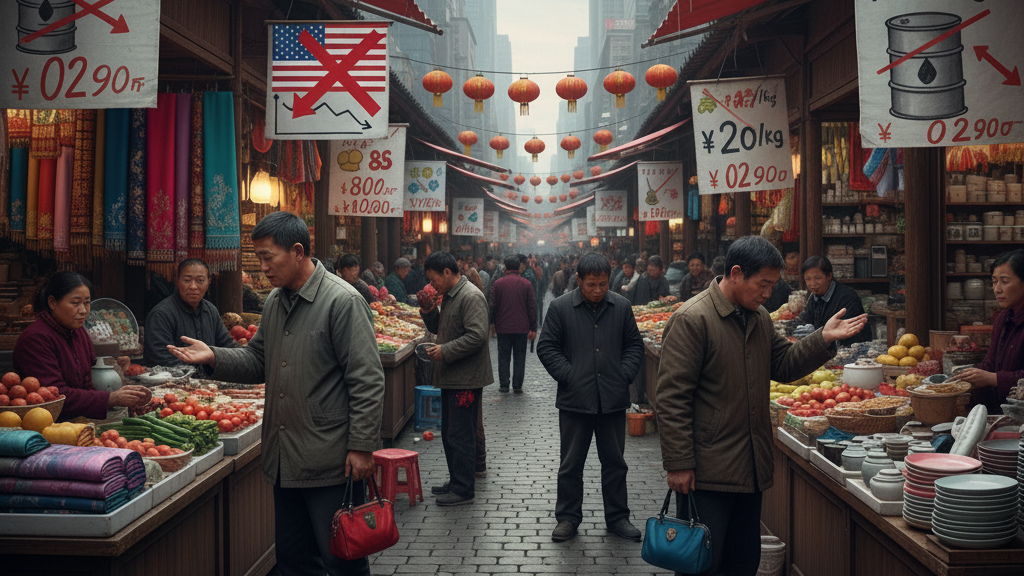
In an already delicate global economy suffering through years of supply disruptions, bouts of inflation, and decelerated consumption, thoughts of a trade war are simply intolerable. It portends a reversal of globalization, instead a politics of isolation. Chinese firms relying on exports from technology to autos simply need a whisper of tariffs to suppress profit forecasts.
The reaction is very emotional, very human. They are not fleeing China’s economy in particular but uncertainty in general the one variable which no model can forecast: political tension.
The geopolitical shadow
Behind this fear, a struggle ensues which is both strategic and economical in nature. The US and China are not rivaling each other in terms of market share alone; they are engaged in a battle to dominate technology and ideology. Semiconductors, artificial intelligence, and clean energy are not industries but battlefields.
Chinese leaders think US restrictions are an attempt to control their country’s rise. US leaders see Chinese industries being given an edge. They are each taking steps to protect and survive because they view everything in a way markets can see as risk.
But in all this rivalry, these two economies are inescapably bound up in each other. No trade war will amount to a clean split but will rather be a wound which will bleed both ways. The Americans need China’s factory system; China needs access to Western technology and markets. The markets are all too well aware of this contradiction in terms, which is whyevery threat of a trade war is rather like two mountaineers sawing each other’s ropes when they are both bound to each other by these ropes.
The domestic struggle
For Beijing, market turmoil comes at a critical moment. Economic revival remains patchy. The property market is slow, youth unemployment remains high, and consumer sentiment remains weak. It will be a challenge for the government to keep a cool head without seeming to be on the defensive.
They have already indicated possible actions such as infusions of liquidity, repurchases, and so forth, but they do not think these monetary policies can mitigate this danger of geopolitical risk. You can stabilize a currency, a financial analyst says, but not a crisis of trust.
Common people are affected by this too. Being Chinese, a crash in stock market prices does not have a negligible impact because millions of middle class people in China keep stocks as a savings option. Shaking a market not only means fluctuation in capital but also in a sense of security.
The world watches
The world outside, on the other hand, is watching with a combination of worry and resignation. European markets have wavered in sympathy, US tech stocks have come under pressure by worries of supply chain disruptions, and commodity prices, ranging from copper to oil, are mirroring this attitude change.
It is a testament to how intertwined the global economy is. A cold in Shanghai can quickly become a freeze in Frankfurt or New York. Once a matter of a bilateral relationship, this struggle now feels like a communal reckoning: a confrontation with how much our economies are wedded to a delicate tightrope of two nations with an increasingly antagonistic attitude towards each other.
Between fear and realism
However, to interpret this slump in terms of pure disaster would be deeply misleading. Market fear is a way of reality too. This is how the system signals a desire for clarity in matters of governance, central banking, and leaders with blurred lines dividing cooperation and competition.
What investors need, rather than a stimulus package or an interest rate cut, is predictability. A trade truce, or limits imposed by both sides in Beijing and Washington, may give markets a breath of fresh air. History tells us that symbolism can pull investors out of a hole quicker than money.
The delicate thread of trust
At the end of the day, it’s not about numbers in the Chinese market but trust the tricky part of all finance, where all finance relies on this one thing: trust in continued growth, in leaders not leading themselves into destruction, in the rules of a global economy.
When this sense of trust is unraveled, all the charts and graphs become nonsense. Prices become a manifestation of fear. Fear, when let loose, will not disappear easily but will linger in the air like smoke after a fire.
Conclusion
What is happening in China’s stock markets is a shock with a global dimension. It is a symptom of a sense of unease with a rapid transition in the international order from cooperation to confrontation. A coming trade war with America may prove to be a threatened disaster, but it demonstrates a vulnerability in the order to optimism, which suddenly gives way to suspicion.
Maybe, just maybe, what stock markets are trying to tell them is this: The world economy functions through dialogue, and dialogue is wearing out. Unless China and America mend this, no amount of stimulus packages will soothe the storm.
Because in the end, markets don’t just measure profit; they measure belief and belief, once shaken, is the hardest currency to restore.
About the Author