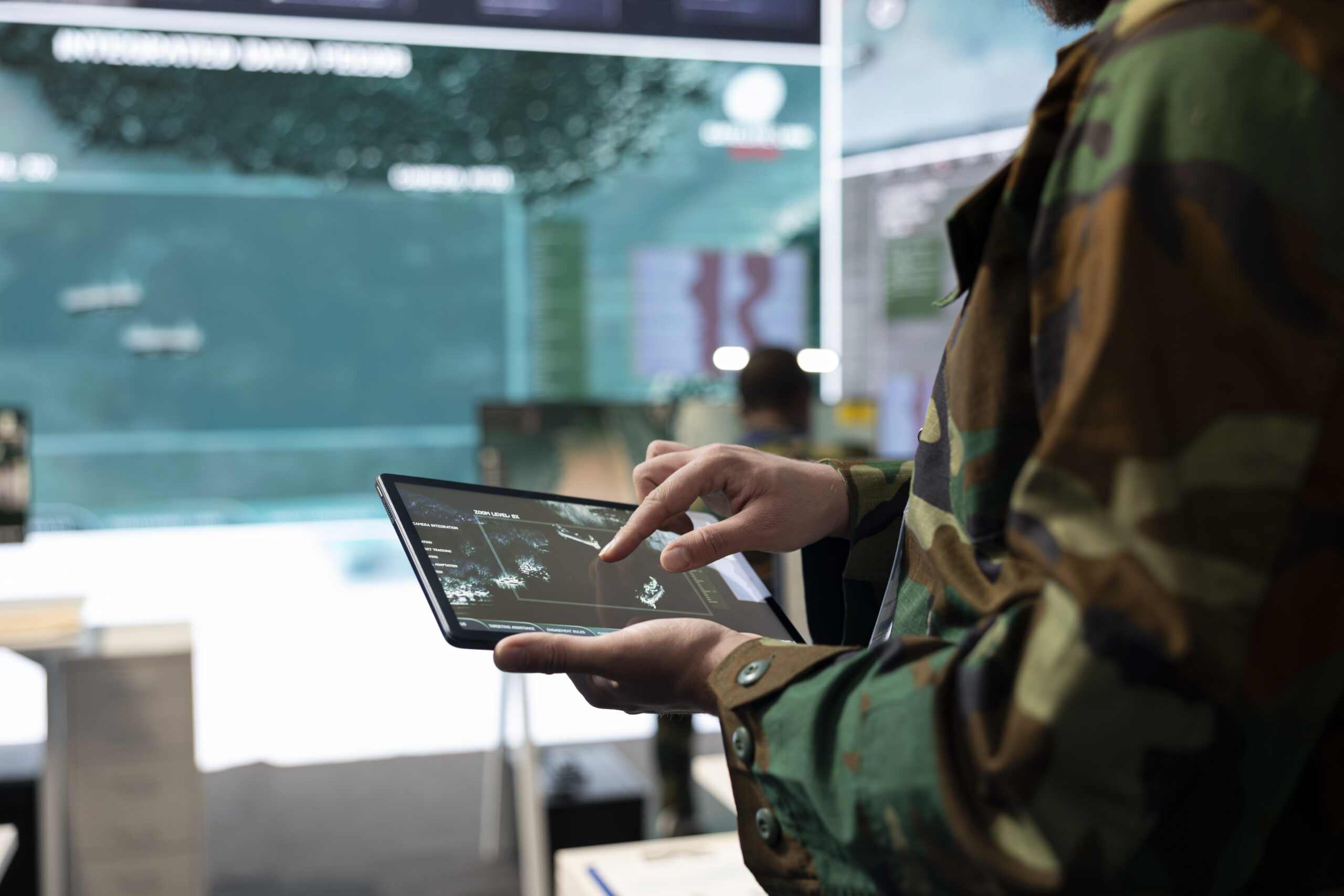
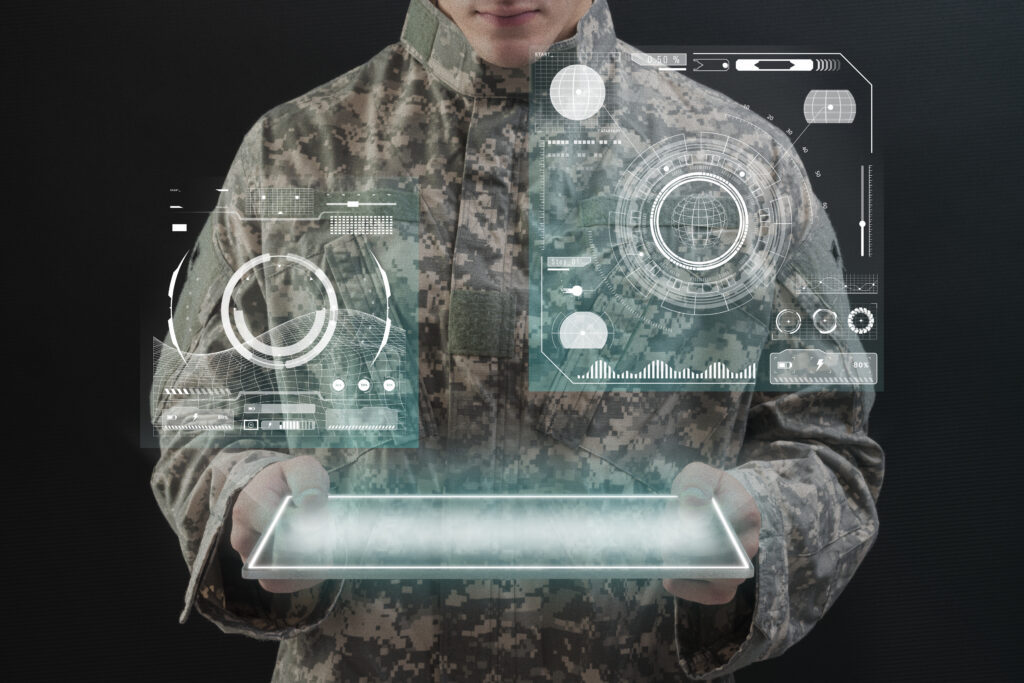
Army recruit examines satellite reconnaissance system on a world map, targeting aircrafts or warships surrounding the national territory. Military staff tracks status of deployed units. Close up.
Introduction
The pace of technological progress always outruns the pace of moral reflection. Rarely, though, has that gap felt as dangerous as it does today. Once a symbol of innovation and hope, Artificial Intelligence is quietly remaking the very way that nations think about power. Beyond medicine, communication, and education, AI is entering this world’s most sensitive sphere of all: war.
The United Nations has sounded the alarm with a warning about an urgent threat: military uses of artificial intelligence without regulation may destabilize global security and erode the very foundations of international law. It is a problem transcending politics. Beneath it is a human question when machines are capable of making decisions about life and death, who bears the moral responsibility?
The UN’s Growing Concern
During the past few years, the UN has been increasingly debating the use of lethal autonomous weapons systems machines that can select and engage targets without human intervention. These scenarios are not from science fiction; these are prototypes being tested by several nations. As it was reported to the UN Convention on Certain Conventional Weapons (CCW), more than thirty countries have already developed or experiment with AI driven weapons systems.
The UN Secretary General, António Guterres, has called the prospect of autonomous weapons “morally repugnant and politically unacceptable.” His words echo a fear that is growing: that of humanity sleepwalking toward a future in which algorithms decide who lives and who dies, according to efficiency, rather than ethics.
The call for binding international regulation isn’t a procedural matter but an existential one. Once autonomous weapons are deployed everywhere, accountability becomes a void, as Guterres and many others have warned. If a drone makes a mistake, where would the blame lie? With the programmer, the commander, or the algorithm itself?
The Race for AI Supremacy
Behind this ethical alarm, a complex geopolitical race lies. The United States, China, Russia, and Israel are all investing heavily in AI based military technologies, seeking strategic advantage through speed, precision, and automation. Military planners call it the next frontier of warfare a shift as transformative as the introduction of nuclear weapons in the 20th century.
AI-powered systems can process data and react at speeds that no human soldier could possibly match. They can identify patterns, predict enemy movements, and make decisions in milliseconds. But that same speed, celebrated as a tactical advantage, is also a profound risk. The potential for miscalculation and unintended escalation grows exponentially without human judgment.
According to a report published by the Stockholm International Peace Research Institute in 2023, deploying unregulated AI into conflict zones risks unleashing “uncontrollable escalation loops.” Consider how autonomous defense systems may misinterpret a radar signal as an attack a single mistake in one algorithm could make an international crisis unfold.
Ethics in the Shadow of War
War has always stretched the limits of morality, but artificial intelligence pushes the concept into a whole new dimension. Traditional warfare, as brutal as it may be, is nonetheless driven by human intent and emotional reserve. Machines do not feel fear, mercy, or doubt-emotions that paradoxically often inhibit further atrocities.
The lack of a human conscience is just what makes autonomous weapons ethically so alarming. As clearly stated by Mary Wareham, advocacy director at Human Rights Watch, “Delegating the power to kill to a machine crosses a moral line that should never be crossed.” The UN echoes this view, as it calls upon all nations to ensure meaningful human control over any system capable of lethal action.
Some military advocates also claim that AI can make war more surgical and less prone to causing collateral damage. However, this reasoning, while too persuasive on the surface, misses a pernicious reality: precision is not morality. A precise strike is not an ethical strike. The technology removes emotion from battle, but it also removes empathy and empathy has always been humanity’s last defense.
The Need for Global Regulation
The UN’s call for clear and enforceable regulation is not a call to halt progress, but to humanize it. Experts propose international treaties similar to those that ban chemical and biological weapons, establishing red lines that no nation can cross.
By 2024, deliberations in the UN’s Group of Governmental Experts on LAWS had reached surprising consensus on issues related to the need for transparency, data accountability, and explicit human involvement within critical decision chains. However, this consensus is fragile. Powerful states resist binding restrictions, concerned that early regulation could stifle innovation or weaken national defense.
This political hesitation has created a dangerous vacuum. While AI technologies race ahead, ethical governance threatens to lag behind. The lesson of nuclear history is clear: when technology outruns regulation, tragedy can often follow. The challenge today is to learn before rather than after.
The Human Responsibility Behind Every Machine
Of course, the deeper question raised by the UN goes beyond just weapons-it’s about the kind of civilization we want to build. AI, by its very nature, reflects our values. If we program it to dominate, it will. If we program it to protect, it can save lives. The line between those two outcomes depends entirely on human intention.
As philosopher Nick Bostrom once said, “The greatest risk of artificial intelligence is not malice, but competence.” A machine does not hate; it simply executes. The danger is not in evil code, but in indifferent design systems built for efficiency without moral context.
This warning from the UN is, in its core, a call to conscience. It reminds us that AI can increase our power but also amplifies our moral responsibility. We can automate decision making but never accountability.
A Turning Point for Humanity
We stand at one of life’s defining moments. Military AI can make the world either much safer that is, through more discriminate defence and fewer human errors or much more dangerous, as dehumanized warfare replaces traditional conflict. It depends on whether humanity acts together with courage now.
The United Nations does not stop at warning states but calls on humanity to reevaluate the morality of power. In a manner similar to how the Geneva Conventions tried to humanize war during an age of industrial violence, so too must the next global framework humanize technology in an age of intelligent machines.
Conclusion
The warning by the UN against the unregulated military use of AI is not alarmism but foresight. It asks us to contemplate not just what AI can do, but what it might undo: human accountability, compassion, and moral restraint.
Technology has always carried the promise of progress, but progress without conscience is peril. As we design machines capable of killing, we must also design systems capable of caring.
Artificial Intelligence can redefine war, but it can never redefine what it means to be human. The UN’s voice, measured yet urgent, reminds us that the future of AI will not be written in code alone it will be written in the values we choose to defend.
About the Author